Choosing an auto car transport company is about more than just price and transit time. Two of the most overlooked — and most important — factors are auto transport insurance and the method of transport itself. Is your vehicle actually covered during the move? Should you ship by truck or consider auto transport by rail?
In this guide, we break down everything you need to know: how to read a certificate of insurance, what to look for before handing over your keys, and the real pros and cons of auto transport via train versus traditional truck-based auto transportation services.
Part 1: Auto Transport Insurance — What You Need to Know
Every legitimate auto car transport company in Canada carries insurance. But not all coverage is created equal. Before you book, you need to understand what's actually protecting your vehicle.
What Is a Certificate of Insurance?
A certificate of insurance is an official document issued by an insurance company that proves a carrier has active coverage. It's not a contract of insurance — it's verification that a policy exists and is in force. Any reputable auto transportation services provider should be able to produce one on request.
If a company can't or won't show you their certificate of insurance, that's a major red flag. Walk away.
How to Read a Certificate of Insurance
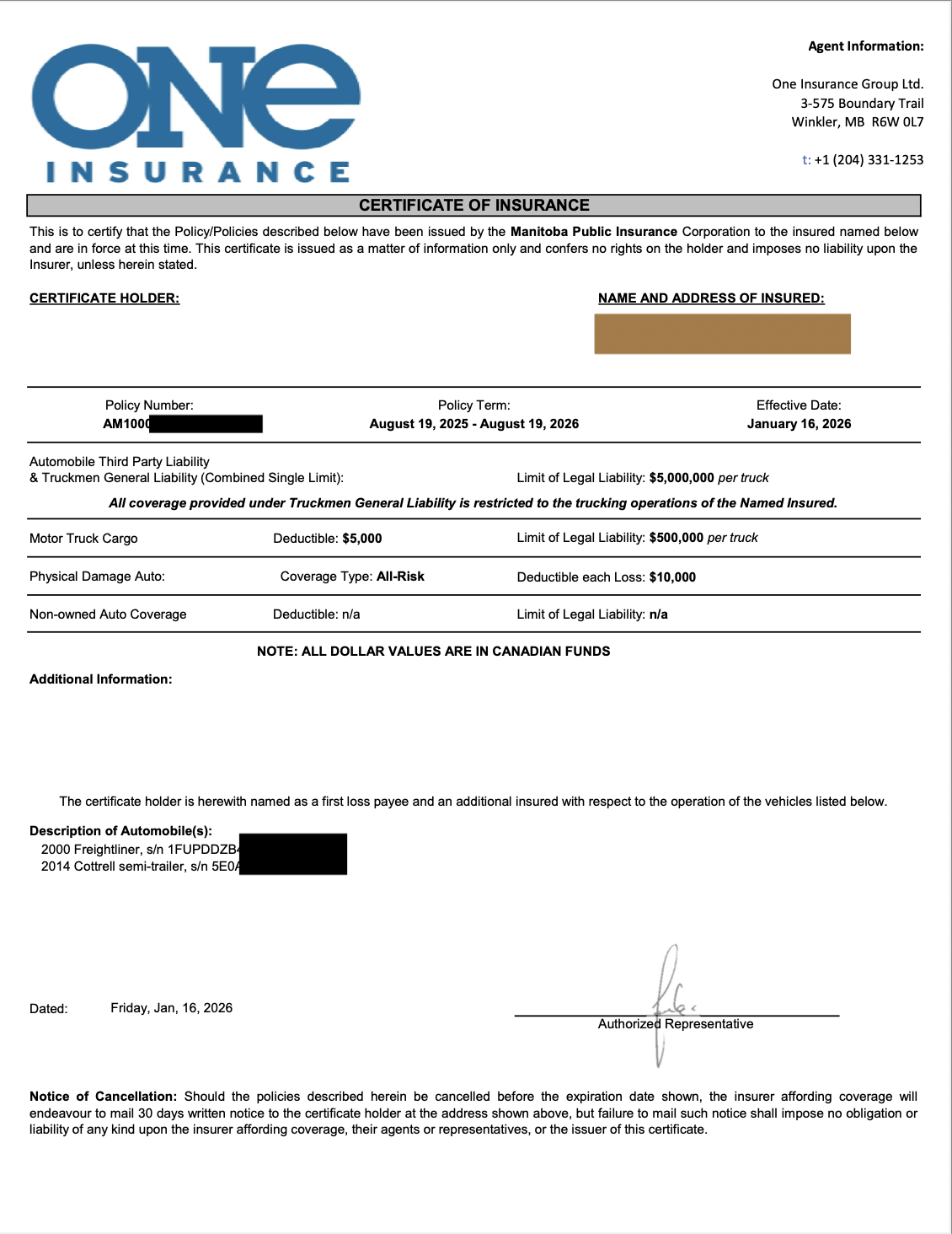
Here's an actual certificate of insurance from a Canadian auto transport operation. Let's break down exactly what you should look for:
Key Fields to Check
1. Policy Dates — Is the Coverage Current?
Look for the Policy Term field. In this example, the policy runs from August 19, 2025 to August 19, 2026. If the current date falls outside this window, the carrier is operating without valid insurance. Never ship with an expired policy.
2. Coverage Type — All-Risk vs. Named Perils
The best coverage you can see is "All-Risk" — this means the policy covers all types of loss or damage unless specifically excluded. Named-perils policies only cover events listed in the policy (like fire or collision) and leave gaps. Always ask for All-Risk.
3. Motor Truck Cargo Coverage
This is the coverage that directly protects your vehicle while it's on the carrier. In the example certificate, Motor Truck Cargo has a $5,000 deductible. This means the first $5,000 of any cargo damage claim is paid by the carrier, not the insurance company. The lower the deductible, the better — but more importantly, confirm this coverage exists.
4. Liability Limits
The certificate shows two key limits:
- Automobile Third Party Liability & Truckmen General Liability: $5,000,000 per truck (combined single limit)
- Legal Liability Limit: $500,000 per truck
The combined $5M liability is strong coverage. Be cautious of carriers with limits under $1,000,000 — that may not be enough to cover a serious incident involving multiple vehicles.
5. Physical Damage Auto Deductible
This covers damage to the carrier's own truck and trailer. In the example, it's $10,000 per loss. While this doesn't directly affect your vehicle's coverage, it tells you about the carrier's overall insurance quality.
6. Named Insured — Does It Match the Carrier?
The Named Insured should be the company that's actually transporting your vehicle. In the certificate, the insured is the carrier operating the equipment. If the company you're dealing with isn't the named insured, ask why — they may be brokering your shipment to another carrier, and you need to verify that carrier's insurance too.
7. Vehicles Listed
The certificate should list the specific truck and trailer being used. In the example:
- 2000 Freightliner (the truck)
- 2014 Cottrell semi-trailer (the car hauler)
This confirms the equipment is insured. If the vehicles aren't listed or don't match what shows up to pick up your car, raise the issue immediately.
8. Canadian Funds
Note that the certificate states: "ALL DOLLAR VALUES ARE IN CANADIAN FUNDS." This matters — some carriers operating cross-border may have coverage quoted in USD. Make sure you understand the currency of the limits.
Red Flags to Watch For
- No certificate available — The carrier refuses or "can't find" their certificate
- Expired policy dates — Coverage has lapsed
- No Motor Truck Cargo coverage — Your vehicle isn't protected
- Very low liability limits — Under $1M is concerning
- Named insured doesn't match — Someone else is actually carrying your vehicle
- Named-perils only — Gaps in coverage that could leave you exposed
Our commitment: At Prairie Auto Transport, we provide our certificate of insurance to any customer who requests it. Full transparency, All-Risk coverage, and $5,000,000 in liability protection per truck. You can download our certificate here or request one before booking.
Part 2: Auto Transport by Rail — Pros, Cons, and Reality
When researching auto car transport options across Canada, you may come across auto transport by rail as an alternative to traditional truck-based shipping. Rail transport uses the CN or CPKC (formerly CP Rail) freight networks with specialized multi-level enclosed railcars designed for vehicles.
Let's break down whether auto transport via train is right for you — or whether sticking with truck-based auto transportation services is the smarter choice.
How Auto Transport by Rail Works
Rail vehicle shipping is not the same as putting your car on a VIA Rail passenger train — that service doesn't exist. Instead, your vehicle goes through a multi-step process:
- Truck pickup — A local carrier picks up your vehicle and drives it to a rail terminal
- Rail terminal processing — Your vehicle is loaded onto a specialized enclosed railcar
- Long-haul rail transit — The vehicle travels via CN or CPKC rail network
- Destination terminal — Vehicle is unloaded at the destination rail yard
- Truck delivery — A local carrier delivers the vehicle from the terminal to your door
So even with "rail shipping," you're still using trucks for the first and last legs. It's really a truck-rail-truck hybrid.
Rail Transport Routes in Canada
CN Rail connects: Vancouver — Edmonton — Saskatoon — Winnipeg — Toronto — Montreal — Halifax
CPKC connects: Vancouver — Calgary — Regina — Winnipeg — Toronto — Montreal
The Pros of Auto Transport by Rail
Lower cost on very long routes. Rail transport costs approximately $0.40–$0.60 per kilometre compared to $0.85+ per kilometre for truck. On coast-to-coast routes like Toronto to Vancouver (4,400 km), this can mean savings of $200–$500.
Enclosed protection. Vehicles travel inside enclosed multi-level railcars, protected from road debris, weather, and UV exposure during the rail segment.
Lower environmental impact. Rail is more fuel-efficient per tonne-kilometre than trucking, making it a greener option for long-distance moves.
The Cons of Auto Transport by Rail
Here's where the reality sets in. While rail sounds appealing on paper, there are significant downsides that most companies won't tell you upfront.
1. Much Longer Transit Times
This is the biggest drawback. A Toronto to Vancouver shipment by truck takes 7–10 days. By rail, the same route takes 9–16 days — and that's just the rail segment. Add in the truck legs at each end, terminal processing delays, and you could be looking at 3+ weeks total.
| Route | By Truck | By Rail (Total) | |-------|----------|----------------| | Toronto → Vancouver | 7–10 days | 14–21 days | | Toronto → Calgary | 5–7 days | 10–16 days | | Winnipeg → Vancouver | 4–6 days | 9–14 days | | Montreal → Toronto | 1–2 days | Not practical by rail |
For shorter routes, rail makes no sense at all — the terminal handling time alone can exceed the entire truck transit time.
2. Corporate Claims Process
When you ship with a family-owned auto car transport company like Prairie Auto Transport, you're dealing directly with the owner if something goes wrong. Claims get resolved quickly because the person you're talking to has the authority to make decisions.
With auto transport by rail, you're dealing with massive corporations — CN Rail, CPKC, and their third-party logistics partners. If your vehicle is damaged, the claims process involves:
- Filing with the rail company's claims department
- Waiting for an internal investigation
- Navigating between the local truck carrier and the rail company over who's responsible
- Dealing with adjusters who handle thousands of claims
This process can take weeks to months. Corporate bureaucracy moves slowly, and you're a small file on someone's desk — not a valued customer. With a family-owned trucking company, a damage claim can often be resolved in days, not months.
3. Storage Fees Accumulate Fast
Once your vehicle arrives at the destination rail terminal, the clock starts ticking. Rail terminals offer very limited free storage time:
- CN Prairie terminals (Calgary, Edmonton, Regina, Saskatoon, Winnipeg): No free time — $2.50/unit/day + $40 gate-in + $40 gate-out
- CN major terminals (Toronto, Montreal, Vancouver): 24 hours free — then $8/unit/day + gate fees
- CPKC terminals: Similar structures with charges starting after free time expires
If you can't arrange pickup immediately — maybe you're traveling, at work, or the local delivery truck isn't available — storage fees pile up daily. On top of that, if the terminal gets congested, your vehicle can be shuttled to an off-site storage yard at $200–$500 per unit, with daily storage of $300/day at some locations.
With truck-based auto transportation services, your vehicle is delivered directly to your door. No terminal pickups, no storage fees, no pressure to drop everything and rush to a rail yard.
4. Non-Running Vehicles Can't Ship by Rail
Rail transport requires a fully running, driveable vehicle. If your car doesn't start, has transmission issues, or can't roll on and off a railcar under its own power, you cannot ship it by rail. Period.
At Prairie Auto Transport, we handle non-running vehicles daily using forklifts in Vancouver, Calgary, Edmonton, Regina, Saskatoon, Winnipeg, and Toronto.
5. Limited Flexibility
Rail operates on fixed schedules with fixed routes between terminals. You can't choose your pickup date as precisely, you can't request specific timing, and there's no option for expedited service. Trucks offer far more flexibility in scheduling, routing, and delivery windows.
6. Terminal-to-Terminal Adds Complexity
Even if you choose "door-to-door" rail shipping, remember that's really three separate legs with three potential handoff points where things can go wrong. Your vehicle changes hands multiple times — from the pickup trucker, to the rail terminal, to the railcar, to the destination terminal, to the delivery trucker. Each handoff is a potential point for delays, miscommunication, or damage.
Rail vs. Truck: Side-by-Side Comparison
| Factor | Truck Transport | Rail Transport | |--------|----------------|---------------| | Transit time | Faster (direct) | Slower (9–21 days) | | Cost (long routes) | Slightly higher | Slightly lower | | Cost (short routes) | Lower | Not practical | | Door-to-door | Yes, direct | Truck-rail-truck hybrid | | Non-running vehicles | Yes (forklift) | No — must be driveable | | Claims process | Direct, fast resolution | Corporate, slow | | Storage fees | None (door delivery) | Start immediately or within 24hrs | | Flexibility | High | Low (fixed schedules) | | Vehicle handoffs | 1 (pickup to delivery) | 3+ (truck-rail-truck) | | Insurance | Carrier's own policy | Split across multiple parties |
Our Recommendation
For the vast majority of Canadian vehicle shipments, truck-based auto transportation services are the better choice. You get faster delivery, direct door-to-door service, a single point of accountability, and a much simpler claims process if anything goes wrong.
Rail transport can make sense in narrow circumstances — specifically long-haul coast-to-coast moves where cost is the primary concern and you have plenty of time. But even then, the added complexity, storage fees, and slower claims process often negate the savings.
Why Choose Prairie Auto Transport?
As a family-owned auto car transport company, we offer what rail and large corporate carriers can't:
- Direct accountability — You deal with real people who care about your vehicle
- All-Risk insurance coverage — $5,000,000 per truck, fully transparent
- Door-to-door service — No terminals, no storage fees, no middlemen
- Non-running vehicle capability — Forklifts in 7 major cities
- Fast claims resolution — If something happens, we handle it directly and quickly
- Certificate of insurance on request — Full transparency, always
Frequently Asked Questions
What is a certificate of insurance in auto transport?
A certificate of insurance is an official document proving that an auto car transport company has active insurance coverage. It shows the policy dates, coverage types, liability limits, deductibles, and the specific vehicles insured. Always request one before shipping your vehicle — any legitimate auto transportation services provider will share it freely.
What should I look for on a certificate of insurance?
Check that the policy dates are current, coverage type is All-Risk, Motor Truck Cargo coverage exists (this protects your vehicle), liability limits are at least $1,000,000, and the named insured matches the company transporting your car. Also verify the deductible amounts and that the truck and trailer are listed.
Is auto transport by rail cheaper than truck?
Rail transport costs approximately $0.40 to $0.60 per kilometre versus $0.85 or more for truck. On very long routes like Toronto to Vancouver, rail may save $200 to $500. However, storage fees at rail terminals, gate charges, and the cost of truck legs at each end can reduce or eliminate those savings.
How long does auto transport via train take in Canada?
Auto transport via train takes significantly longer than truck. Toronto to Vancouver by rail takes 9 to 16 days for the rail segment alone, plus truck pickup and delivery time at each end. Total door-to-door time is typically 14 to 21 days compared to 7 to 10 days by truck.
Can I ship a non-running vehicle by rail?
No. Auto transport by rail requires a fully running, driveable vehicle that can roll on and off the railcar under its own power. If your vehicle is non-running, you need truck-based auto transportation services with forklift capability.
What happens if my vehicle is damaged during rail transport?
If damage occurs during auto transport by rail, you file a claim with the rail company's claims department. Because multiple parties are involved (pickup trucker, rail company, delivery trucker), determining responsibility can be complex and time-consuming. Claims with corporate rail companies can take weeks to months to resolve, compared to days with a family-owned truck carrier.
Get your free quote for fully insured auto car transport →
Or call us at (204) 332-1935 — we'll answer any insurance questions and get your vehicle moving.